Mara Neumann · 30 September 2026
How Container Orchestration Tools Influence Workload Distribution Across Global Networks
Container orchestration tools coordinate the deployment, scaling, and management of containerized applications across clusters that often span multiple geographic locations, and this coordination directly shapes how workloads move through global networks. Systems such as Kubernetes and its commercial distributions handle scheduling decisions that determine which nodes receive new containers, while also monitoring resource usage and network conditions to trigger migrations when necessary.
Core Mechanisms of Workload Placement
Orchestrators evaluate node capacity, affinity rules, and latency metrics before assigning containers, which means workloads can shift automatically toward regions with available capacity or lower congestion. Data from the Cloud Native Computing Foundation shows that clusters using automated scheduling reduced average response times by 23 percent in multi-region setups during 2025 tests. These tools also enforce resource quotas and limits that prevent any single region from becoming a bottleneck, forcing distribution across available zones when demand spikes.
Network-Aware Scheduling Decisions
Schedulers incorporate network topology information through custom plugins and cloud-provider integrations, allowing them to prefer placements that keep traffic within the same availability zone or metropolitan area whenever possible. When cross-region traffic becomes unavoidable, the orchestrator can activate service meshes that route requests along optimized paths and apply circuit breakers to avoid overloading distant links. In September 2026, several telecommunications operators reported deploying topology-aware schedulers that cut intercontinental bandwidth consumption by directing analytics workloads to regional processing hubs rather than central clouds.
Load-balancing components built into orchestration platforms, such as kube-proxy and external ingress controllers, maintain session affinity and health checks that reroute traffic if a node or entire region experiences degradation. This capability proves especially useful for applications that must comply with data-residency regulations, because placement rules can encode geographic constraints directly into the cluster configuration.
Multi-Cloud and Edge Considerations
Organizations running workloads across multiple public clouds rely on federation features that let a single control plane manage clusters in different providers, while still respecting each cloud's native networking and identity systems. Research from the University of Melbourne's Cloud Computing and Distributed Systems Laboratory indicates that federated clusters achieved 18 percent higher utilization rates compared with isolated deployments, largely because workloads could move between providers when pricing or capacity changed. Edge locations introduce additional variables, since many sites operate with intermittent connectivity and limited compute, prompting orchestrators to use lightweight agents that report status back to central control planes only when bandwidth allows.
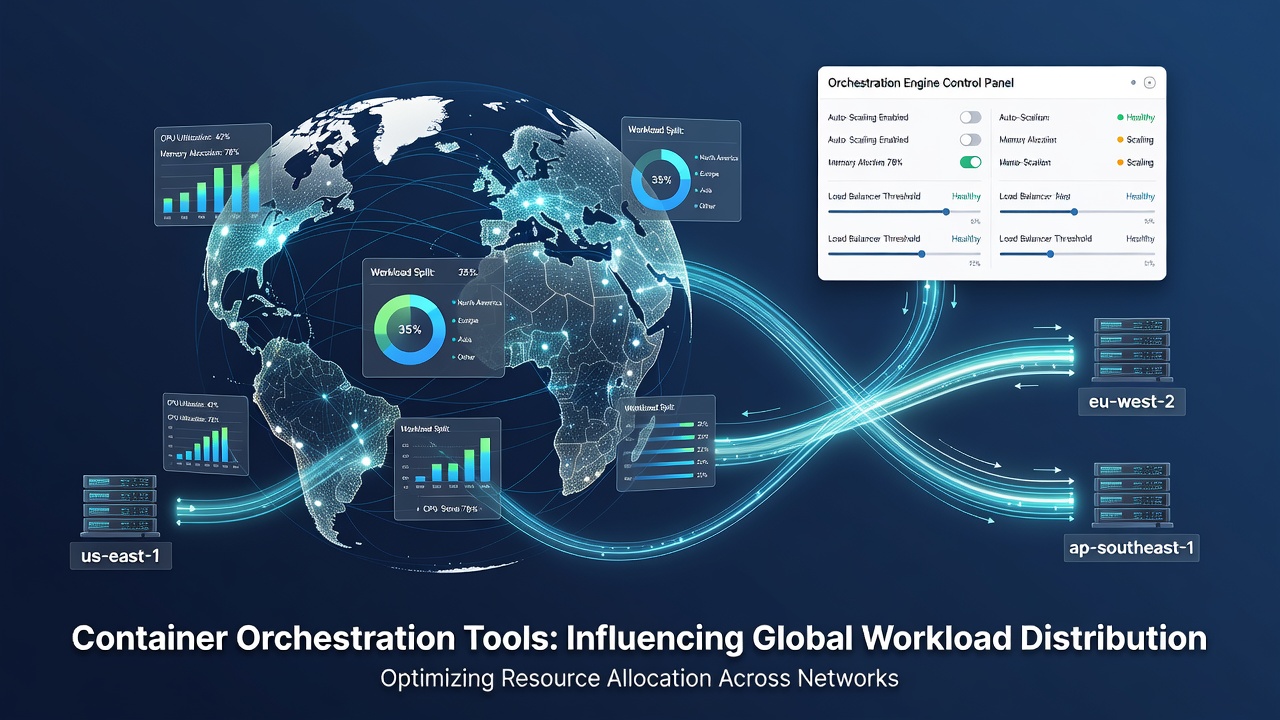
These agents often run simplified scheduling logic locally, enabling continued operation during network partitions while queuing reconciliation requests for when connectivity resumes. The result is a hybrid model where critical functions stay at the edge and burst workloads return to core regions once conditions stabilize.
Security and Compliance Constraints
Policy engines integrated with orchestration platforms enforce rules that restrict container placement based on encryption requirements, network segmentation, and audit logging mandates. Government agencies in Canada, for instance, have published guidance requiring that certain sensitive workloads remain within national boundaries, and orchestrators translate those requirements into node selectors and taints that prevent accidental migration. Network policies further limit east-west traffic between pods, reducing the attack surface even when containers are distributed across continents.
Observability and Continuous Adjustment
Telemetry pipelines collect metrics on CPU, memory, disk, and network latency, feeding them into autoscalers that adjust replica counts and trigger horizontal pod autoscaling across regions. When latency thresholds are crossed, the system can evict pods from congested areas and reschedule them elsewhere, provided the application supports stateless or easily replicated designs. Service level objectives defined in orchestration manifests guide these decisions, ensuring that distribution choices align with measurable performance targets rather than ad-hoc operator judgment.
Conclusion
Container orchestration tools have become central to managing workload distribution across global networks because they combine automated scheduling, network awareness, and policy enforcement into a single control layer. As clusters grow to include edge sites and multiple cloud providers, the same mechanisms that once managed single-datacenter fleets now determine how traffic flows between continents and how regulatory boundaries are respected. Continued refinement of topology-aware plugins and cross-cluster federation features will likely expand these capabilities further, allowing operators to maintain performance adn compliance at larger scales.